
Electric Gate Repair Cost in Chicago: $150–$900 Depending on Whether Your Problem Started in the Ground or the Circuit Board
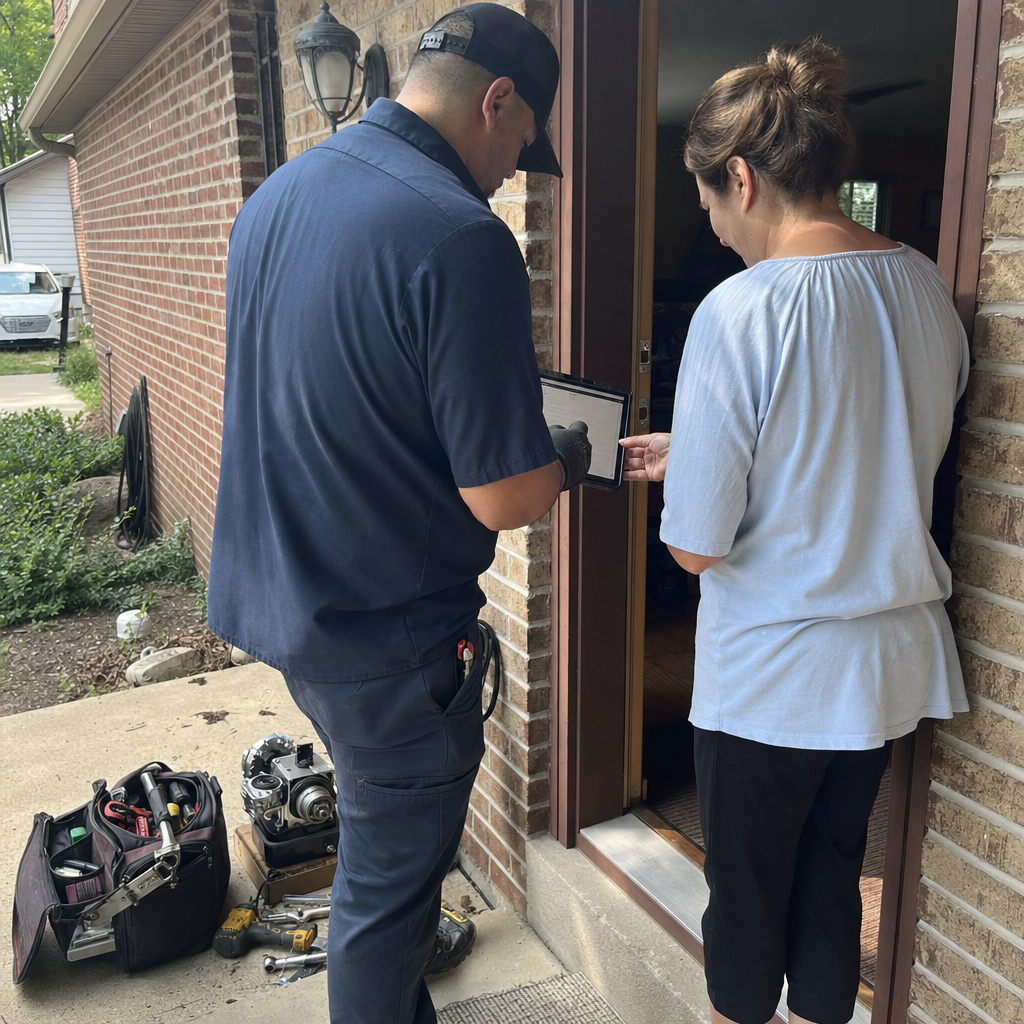
Most our Gate Repair services in Chicago fall between $150 and $550 for electrical issues and $200 to $900 for structural problems, with same-day service available across the metro. Call (866) 406-5812 for a free estimate — Jason Reed, our Owner and Lead Technician, can usually narrow your cost range over the phone once he knows what the gate is doing. We service LiftMaster, FAAC, Elite, Mighty Mule, and five other major brands with the parts already stocked.
Why Chicago Has Two Completely Different Gate Repair Seasons
We get two distinct call surges every year. One hits in March and April when the ground thaws and every gate that was borderline last fall is now broken. The second comes in August when heat-stressed control boards finally give out. The repair costs look very different depending on which wave you’re in.
This isn’t a mild-climate pattern. Chicago’s frost line sits around 42 inches deep, and our heavy clay soils amplify freeze-thaw heaving far beyond what sandy suburbs experience. A gate post anchored at 30 inches — common on older installations — shifts out of plumb every winter, progressively destroying hinges, latches, and eventually the frame itself. Meanwhile, Lake Michigan’s salt-laden humidity corrodes outdoor wiring terminals and receiver housings at rates inland cities at the same latitude don’t see.
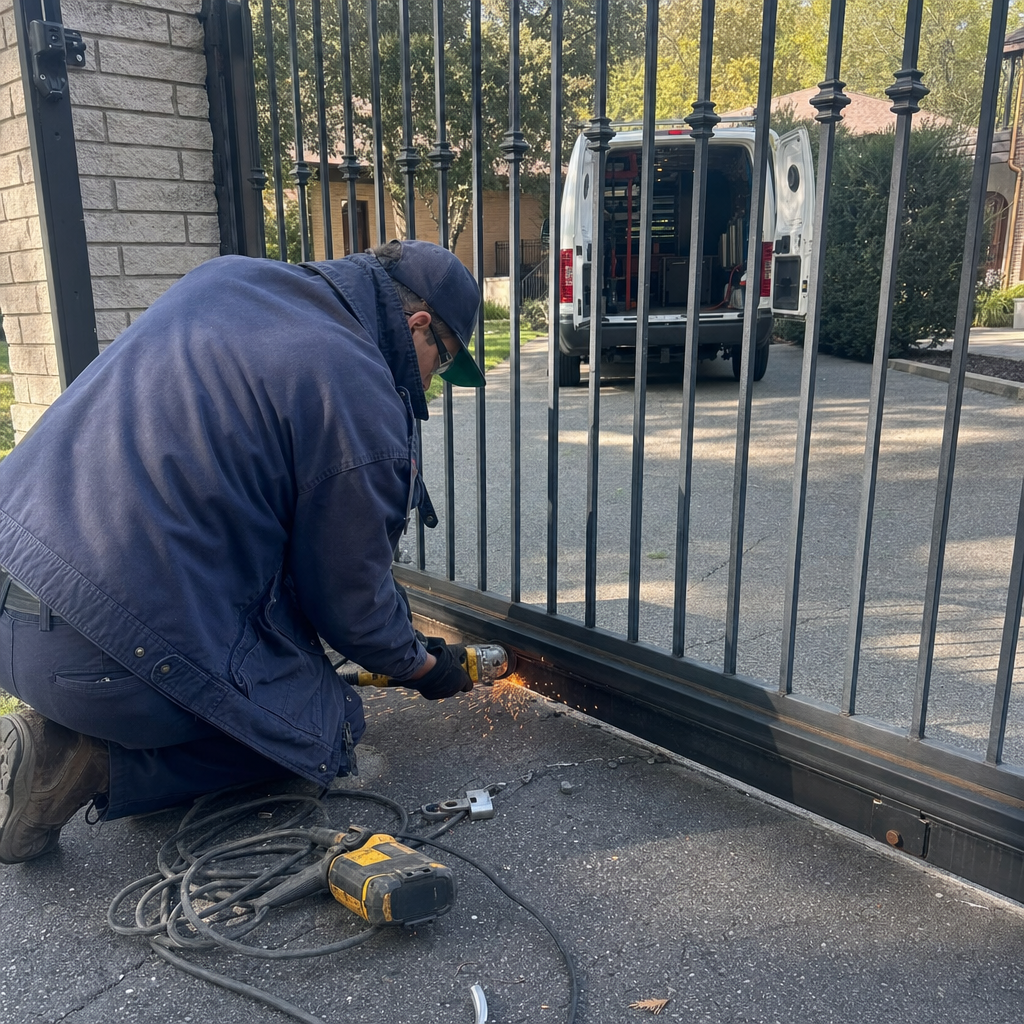
That seasonal split matters for your wallet. Spring thaw repairs are structural: post realignment, hinge replacement, broken weld repairs. Summer and fall repairs are electrical: control boards, receivers, wiring runs, limit switches. Knowing which category you’re in gets you a much tighter estimate before anyone shows up.
Spring Thaw Damage: The Structural Cost Tier ($200–$900)
On the northwest and southwest side bungalow belts — Portage Park, Archer Heights, Brighton Park — alley gate posts were almost universally set in shallow piers that don’t reach the frost line. After 60 to 80 winters of heaving, a leaning or non-latching alley gate is essentially the default condition. We work these blocks systematically, and the repair scope follows a predictable pattern.
The city’s approximately 1,900 miles of paved alleys create a repair context unlike anywhere else in the country. Nearly every residential lot backs up to one, meaning the dominant gate type we see is rear alley-access gates serving detached garages, not front driveway gates. These are older, heavier, and more mechanically stressed than the lighter ornamental gates common in other markets.
Here’s what spring structural repairs typically run:
| Repair Type | Cost Range |
|---|---|
| Post realignment (single post, reset below frost line) | $200–$400 |
| Hinge replacement (standard pintle or barrel hinge) | $150–$300 |
| Broken weld repair (gate frame or hinge mount) | $200–$450 |
| Full hinge and pintle set replacement | $300–$550 |
| Frame straightening plus weld repair | $400–$700 |
| Post replacement with concrete pier (includes gate removal/rehang) | $600–$900 |
Chicago’s housing stock drives these numbers up in specific ways. The bungalows, two-flats, three-flats, and greystones built from the 1910s through the 1940s mostly carry original or near-original ornamental wrought iron or steel alley gates. These weren’t designed for modern automation, and they require welding and custom hardware fabrication rather than off-the-shelf part swaps. We fabricate brackets and reinforcements in-house rather than ordering generic kits that don’t fit.
The deferred repair trap is real here. A $250 hinge fix ignored through winter becomes a $900 frame-and-hinge job by spring. We’ve seen it repeatedly in Chicago’s alley-gate economy — the gate still “works” until it doesn’t, and by then the post has tilted far enough that the automatic opener is fighting structural misalignment every cycle. That strains the motor, burns out the control board, and turns a mechanical problem into a mechanical-plus-electrical problem.
Electrical Season: The Electronic Cost Tier ($150–$550)
When August heat peaks, we start getting Emergency Gate Repair in Chicago, IL calls about gates that move erratically, stop mid-cycle, or don’t respond to remotes at all. The root cause is rarely the motor itself — despite what less specialized technicians often diagnose. After 14 years of Chicago-specific gate failures, Jason Reed has built a diagnostic pattern that starts with the cheapest components first: limit switches, safety loops, photocells, then control boards, then motors last.
The Lake Michigan humidity factor shows up here in ways that surprise property owners. Salt-laden air accelerates corrosion on outdoor wiring terminals and receiver housings. A control board housed in a standard enclosure — adequate for inland installs — often fails prematurely in Chicago’s climate. We specify weatherproof enclosures with sealed cable entry as a repair standard here, not an upgrade option.
Electrical repair costs break down as follows:
| Repair Type | Cost Range |
|---|---|
| Limit switch adjustment or replacement | $150–$250 |
| Photocell or safety sensor replacement | $150–$280 |
| Remote receiver replacement | $180–$320 |
| Control board replacement (brand-dependent) | $250–$450 |
| Wiring repair or conduit replacement (short run) | $200–$350 |
| Motor replacement (includes alignment) | $350–$550 |
Our brand fluency matters for these numbers. We work on LiftMaster, FAAC, Elite, and Mighty Mule systems every week — we know them cold. That means we arrive with the most common failure parts for the nine brands we service, reducing return trips and the associated second-visit labor costs. A technician who has to order a board and come back charges you twice. We don’t.
Safety note: Electric gate systems carry live 120V or 240V power and can exert crushing force during operation. Control boards retain stored voltage even when disconnected. We don’t recommend property owners open enclosures or attempt electrical diagnosis — the risk of serious injury or equipment damage outweighs any potential savings. Our team is trained to isolate power, discharge capacitors, and test safely.
What Chicago’s Clay Soil Does to Electrical Components Indirectly
Here’s a detail most cost guides miss entirely. Chicago’s clay soil heaving is more severe than sandy-soil suburbs, meaning city alley gates sustain structural stress on their electrical components indirectly. A corroded connection or cracked conduit is often traced back to post movement, not component age.
The mechanism is straightforward: a post tilts, the gate frame twists, the conduit run between post and gate flexes beyond its design limit, moisture enters at the stress crack, and six months later the control board throws an error code that looks like electronics failure. A generalist technician replaces the board, the underlying flex continues, and the new board fails within a year. We’ve diagnosed this exact chain on Elite and FAAC systems in Portage Park and Brighton Park — the fix was post realignment and conduit replacement, not another board swap.
This is where gate-only specialization pays off. We don’t treat gate work as a secondary service or a sideline to fencing. Fourteen years of gates, nothing else, means we recognize the soil-to-electronics failure path that general contractors miss. Jason Reed — Owner and Lead Technician — works your job directly, and he’s seen this pattern enough times to check it first.
Common Local Scenarios: What We Actually See on Chicago Jobs
These are the calls that come in repeatedly, with the cost context that helps you gauge where you land.
- The March “gate won’t close” call: Usually a hinge pintle sheared off during the last freeze-thaw cycle. The gate hangs crooked, the automatic closer can’t pull it to the latch, and the safety sensor sees an obstruction that isn’t there. Cost: $200–$400 for hinge repair and sensor realignment. If the frame is twisted from the sag, add $150–$300 for weld repair.
- The August “remote stopped working” call: Often a receiver board with corroded antenna terminals from humidity exposure. We see this on Mighty Mule and LiftMaster systems near the lakefront especially. Cost: $180–$320 for receiver replacement, plus weatherproof enclosure upgrade if the original was underspecified for Chicago conditions.
- The “opener runs but gate doesn’t move” call: Frequently a stripped drive gear or broken chain on slide gates, or a detached arm on swing gates. But we also see this misdiagnosed as motor failure when the real issue is a limit switch that won’t register “closed” — the motor runs until thermal overload kicks in. Jason’s approach: “Tell me what it’s doing — or not doing — and I can usually tell you what’s wrong before I pull into your driveway.” Limit switch: $150–$250. Misdiagnosed motor replacement you didn’t need: $350–$550.
- The “gate hits the post every time it opens” call: Post shift from frost heave, plain and simple. Common on shallow-set piers in Archer Heights and Brighton Park. Cost depends on whether we can realign or need to reset: $200–$400 for realignment, $600–$900 if we need to pull and re-pour.
- The “everything worked until the first hard freeze” call: Usually a combination — a slightly loose hinge got worse, the gate sagged onto the safety loop, and the control board logged enough fault cycles to burn out a relay. Structural plus electrical, starting around $400 and scaling with gate size and access constraints.
What Drives Costs Up — And How to Avoid It
The single biggest cost escalator we see is deferred maintenance on mechanical issues. A gate that makes noise, drags, or needs a manual push to start its cycle is telling you something. The automatic opener compensates until it can’t — then you’re replacing a $250 hinge and a $400 control board.
Other factors that push Chicago repairs toward the high end:
- Alley access constraints: Narrow passages, parked cars, and overhead utility lines can make equipment positioning difficult. We manage this regularly, but it affects labor time.
- Custom fabrication needs: Original wrought iron gates on Chicago bungalows rarely match modern hardware patterns. Off-the-shelf brackets don’t fit. Our welding capability eliminates the “we’ll have to order something” delay.
- Brand parts availability: Some older Elite and DoorKing systems use discontinued boards. We source compatible replacements or retrofit with current-generation controls, but this requires more diagnostic time than a straight swap.
- Multiple failure points from single root cause: The clay-soil-heave-to-electrical-failure chain described above. Fixing only the symptom guarantees a repeat call.
How Our Pricing Works
We don’t charge diagnostic fees that get waived only if you approve the repair. Our service call includes the diagnostic — Jason Reed evaluates the full system, identifies the root cause, and gives you a flat repair price before any work begins. If there are multiple valid approaches (repair versus replace, for example), we explain the trade-offs in terms of expected lifespan and total cost.
Our 639 customer reviews at a 4.7-star average reflect this transparency. Customers know what they’re paying for and why. From a broken hinge weld to a full access-control install — one call covers it. We don’t subcontract to rotating crews; Jason leads every job personally with 14 years of focused gate expertise.
For property managers and landlords with multiple buildings, we maintain gate histories and can flag emerging problems before they become emergency calls. The alley-gate economy in Chicago is predictable once you know the housing stock and soil conditions. We’ve worked these patterns long enough to anticipate them.
FAQs
Electric gate repair in Chicago typically costs $150 to $550 for electrical issues and $200 to $900 for structural problems, with most homeowners landing in the $250–$500 range for single-point repairs. See our How Much Does Gate Repair Cost? (2026 Price Guide) — Chicago, IL for a full breakdown. Call (866) 406-5812 for an exact quote — estimates are free and Jason Reed can usually narrow the range once you describe what the gate is doing.
Repair is almost always cheaper for Chicago’s older iron and steel alley gates, since replacement requires custom fabrication to match existing architecture — often $2,500–$5,000 versus a $400–$900 repair. Replacement makes more sense when the frame is extensively rusted, multiple welds have failed, or you’re upgrading from manual to automatic operation. We’ll tell you honestly which path fits your gate’s condition.
Yes — same-day service is available throughout Chicago for most brands we support, including LiftMaster, FAAC, Elite, and Mighty Mule. We stock common failure parts for all nine brands we service, which eliminates the ordering delays that push other technicians to second visits. Call (866) 406-5812 before noon for best availability.
Chicago’s freeze-thaw cycle shifts gate posts that aren’t anchored below the 42-inch frost line, which misaligns hinges and stresses the automatic opener until something fails — usually a hinge, weld, or safety sensor first, then the control board if the problem persists. The clay soil here heaves more severely than sandy suburbs, so even gates that “were fine last fall” often fail in March and April. A spring inspection after a hard winter catches these shifts before they cascade into multiple component failures.
Get Your Free Estimate Today
Whether your gate failed in the spring thaw or the August heat, we’ll Gate Repair Near Me in Chicago, IL diagnose the root cause and give you a flat repair price before any work begins. No diagnostic fees, no subcontracted crews — just Jason Reed, Owner and Lead Technician, with 14 years of Chicago gate experience and parts for LiftMaster, FAAC, Elite, Mighty Mule, and five other major brands already on the truck. Call (866) 406-5812 for your free estimate.
Written by Jason Reed, Owner & Lead Technician at Fortress Gate Repair Greater Chicago, serving Chicago, IL.