
Why Won’t My Automatic Gate Open? Chicago’s Most Common Causes
If your automatic gate won’t open, the most likely cause in Chicago is mechanical binding from frost-heaved posts — not a dead motor or bad remote. Every February and March, we field dozens of calls where the operator hums but the gate won’t budge, and the real problem is the frame has shifted against the post after another winter of clay-soil heaving. Before you replace any electronics, check whether the gate moves freely by hand. If it doesn’t, you’re looking at an alignment issue, not a motor failure. Call (866) 406-5812 if you want us to confirm it — estimates are free, and we can often diagnose over a quick video call.
How Chicago’s Alleys and Winters Destroy Gate Alignment
Chicago’s approximately 1,900 miles of paved alleys create a gate-repair context unlike anywhere else in the country. Nearly every residential lot backs up to an alley, and those rear-access gates — mostly original wrought iron or steel on bungalows, two-flats, and three-flats built between 1910 and 1940 — take a beating that front-driveway gates in other cities never see.
The northwest and southwest side bungalow belts — Portage Park, Archer Heights, Brighton Park — are where we see this most predictably. Alley gate posts in these neighborhoods were almost universally set in shallow piers that don’t reach Chicago’s 42-inch frost line. After 60 to 80 winters of freeze-thaw cycling in heavy clay soil, a leaning or non-latching gate isn’t a flaw — it’s the default condition block by block.
Here’s what happens: water saturates the clay, freezes, expands, and pushes the post out of plumb by spring. The gate frame, still square, now binds against a shifted post. The motor — whether it’s a LiftMaster, FAAC, or Mighty Mule — detects the overload and shuts down, or strains until it burns out. We see technicians misdiagnose this as motor failure constantly. They quote $800–$1,400 for a new operator when the real fix is re-plumbing the post, rehanging the gate, and adjusting the limit switches — sometimes half the cost, sometimes less.
Jason Reed — Owner and Lead Technician — grew up in Bridgeport a few blocks from Comiskey, learned motors and controls through Triton College’s HVAC and Industrial Maintenance program in River Grove, and has spent 14 years narrowing his focus to exactly this problem set. “Tell me what it’s doing — or not doing — and I can usually tell you what’s wrong before I pull into your driveway.”
The Three States of Gate Failure (And What Each Means)
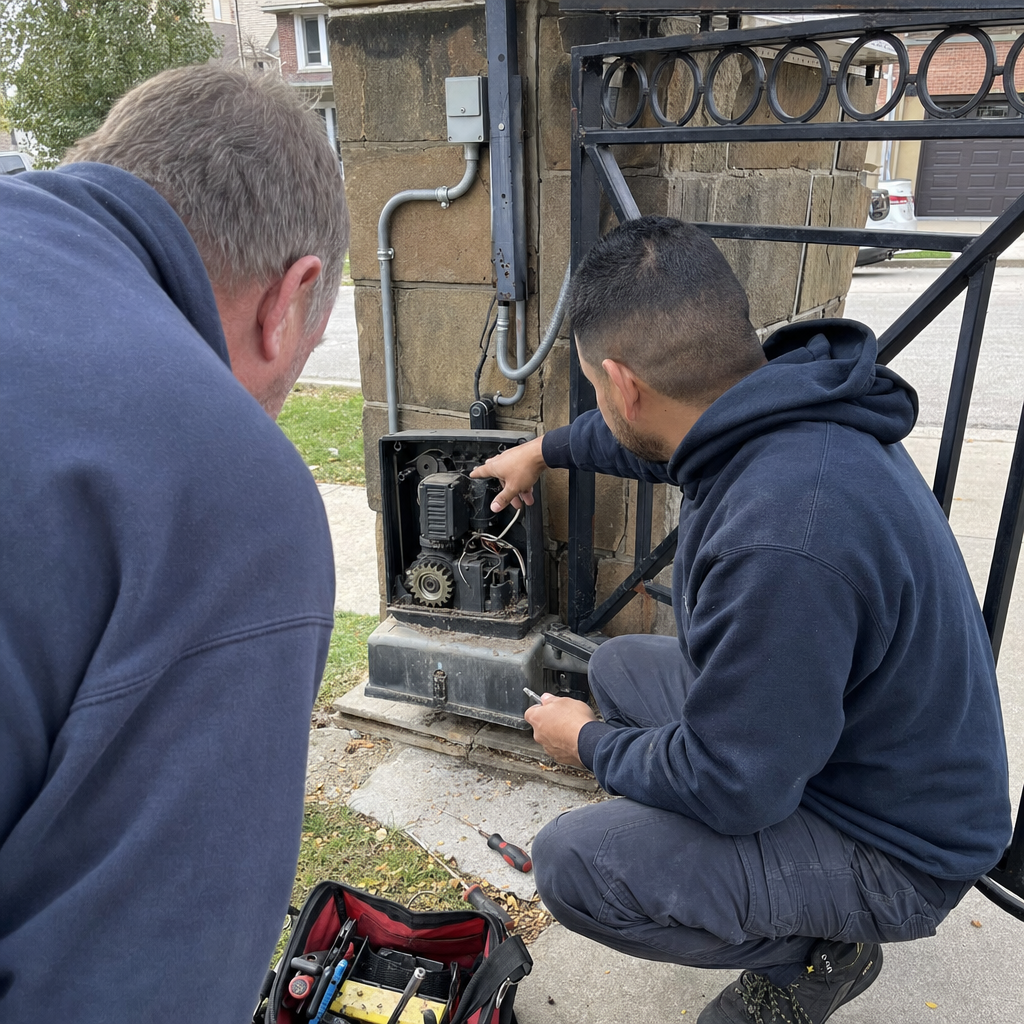
When a customer calls and says “my gate won’t open,” the first thing we ask is what the motor is actually doing. There are only three states, and they point to completely different causes:
- Motor humming but gate not moving: This is the binding scenario — frost heave, bent frame, stuck drop rod, or latch catch misalignment. The motor is fine; it’s hitting resistance it can’t overcome.
- Motor running but gate moving slowly or partially: Often a failing capacitor, worn gears in the operator, or a gate that’s binding only at one point in its swing or slide cycle. Could also be a limit switch that needs recalibration after post shift.
- No motor sound at all: Electrical fault — dead control board, failed receiver, tripped breaker, corroded terminal, or bad transformer. Lake Michigan humidity accelerates corrosion in post-mounted junction boxes; we see this constantly on older LiftMaster and FAAC units.
Knowing which state you’re in saves you from replacing parts that aren’t broken. We’ve had customers in Portage Park tell us another company quoted a full motor replacement for a gate that just needed its latch catch ground down where frost heave had raised the strike plate.
Jason’s Diagnostic Sequence: What We Check First, Second, Third
After 14 years of gates and nothing else, we’ve developed a sequence that catches the real problem fast — and sometimes lets us narrow it before we even drive out.
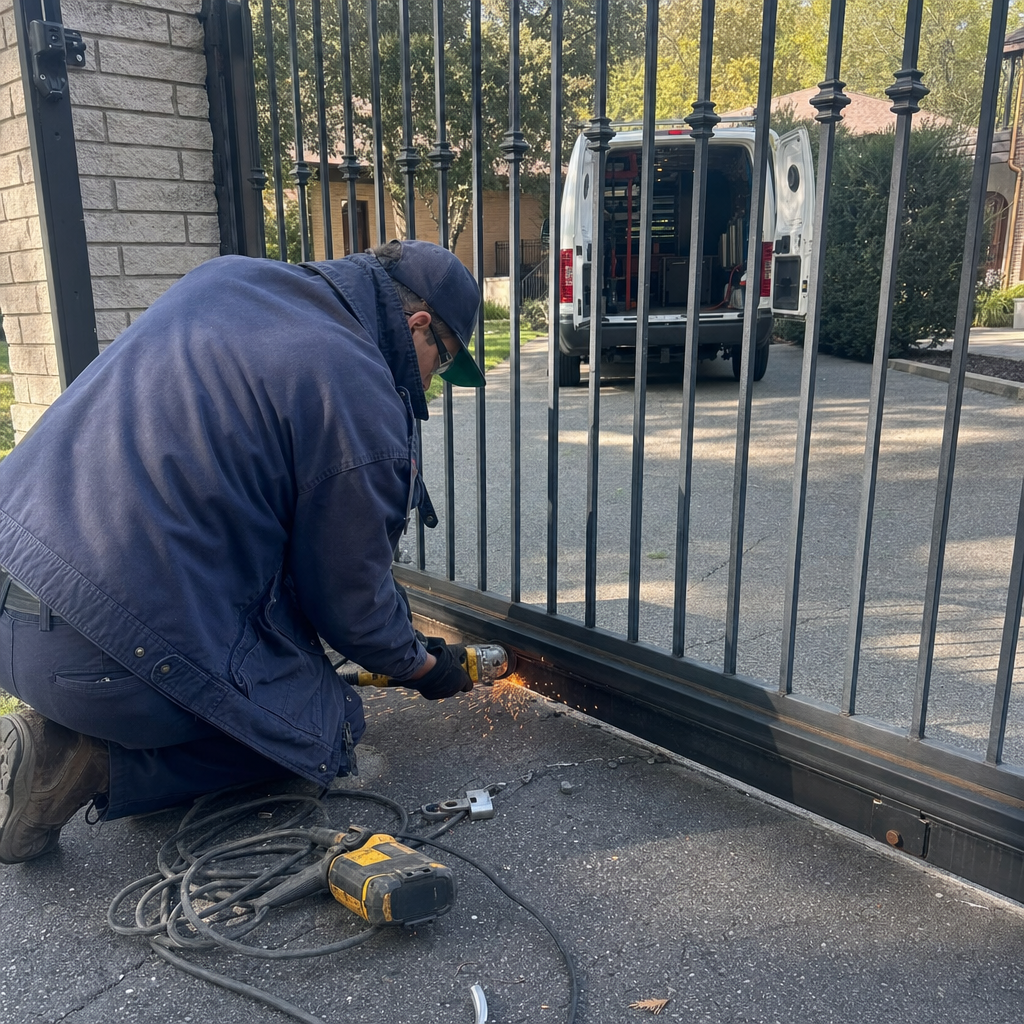
First: the hand-push test. Disconnect power to the operator and try to move the gate manually. If it won’t budge or grinds at a specific point, you’ve got a mechanical bind. We look for post lean, hinge pintle wear, frame twist, or interference with the ground or adjacent structure. On Chicago’s original iron gates, broken welds at hinge points are common — we fabricate and weld these in-house rather than replacing the whole gate.
Second: motor behavior under load. Reconnect power and trigger the operator while watching and listening. A healthy motor that stalls immediately is protecting itself against overload — good sign for the motor, bad sign for alignment. A motor that strains, slows, then stops may have a failing start capacitor or worn internal gears. A motor that clicks but never turns often has a dead control board.
Third: electrical isolation. If the motor checks out mechanically, we test power at the operator, then at the control board, then at the receiver module. We see three electrical failures repeatedly in Chicago: dead control boards on units older than 8–10 years, failed receiver modules (especially after power surges), and corroded wire terminals at the post junction box where salt spray and humidity meet. The corrosion is usually green or white buildup on copper — visible if you know to look.
Remote versus keypad: This is the simplest diagnostic step most people miss. If your gate opens from the hardwired keypad but not the remote, the motor and control board are fine — the fault is in the receiver or the remote battery. We’ve saved customers a service call just by having them test this over the phone.
For straightforward cases, we’ll do a quick video call. Show us the gate, the operator, and describe the sound. We can often tell you whether you’re looking at a Automatic Gate Repair Cost in Chicago, IL scenario like a $180 alignment adjustment or a $650 control board replacement before we leave the shop.
When Electrical Components Actually Fail (And What It Costs)
Once we’ve ruled out mechanical binding, these are the electrical failures we see most in Chicago’s climate:
| Component | Typical Cause | Price Range in Chicago |
|---|---|---|
| Control board replacement | Age, humidity corrosion, power surge | $340–$650 |
| Receiver module | Lightning surge, moisture ingress | $180–$340 |
| Remote / keypad | Battery, physical damage, programming loss | $45–$180 |
| Capacitor / start component | Age, heat cycling | $120–$220 |
| Wire terminal repair / junction box | Salt corrosion, rodent damage | $150–$280 |
These prices include parts and labor. We don’t charge diagnostic fees if you proceed with the repair — the assessment is built into the job. For context, a misdiagnosed “motor replacement” that another company quotes at $1,200–$1,800 often resolves for $280–$450 when the real problem is a control board or alignment issue, which affects your Electric Gate Repair Cost in Chicago, IL significantly.
We work on LiftMaster, FAAC, BFT, and Mighty Mule systems every week — we know them cold. That brand fluency matters because control boards and receiver modules aren’t interchangeable; you need a technician who can source the right part and program it correctly the first time.
Seasonal Timing: Why February and March Are Gate Failure Season
Chicago’s frost heave doesn’t peak until late winter, when the freeze line is deepest and the thaw cycles begin. That’s why we see the spike in calls then, not in December when it’s consistently frozen. The repeated freeze-thaw of February and March works gate posts loose progressively; by early spring, the cumulative shift is enough to cause binding.
Road and sidewalk salt spray adds another layer. Salt accelerates rust on iron gates and corrodes electrical connections faster than in inland cities at this latitude. Combined with Lake Michigan humidity, we’ve seen junction boxes that look fine on the outside with terminals completely degraded inside.
The housing stock makes this predictable. Those original ornamental gates on Chicago bungalows and greystones weren’t designed for automatic operators — they were hand-operated for decades. Adding a motor to a 90-year-old gate frame with 60 years of post heave is a recipe for misalignment unless someone checks the mechanical condition first. We do that check on every job. Gate Repair is what we handle start to finish.
What You Can Check Safely (And What to Leave Alone)
You can do a few things before calling, but we draw a hard line at safety. Gate operators contain high-tension springs and heavy moving parts — we don’t provide step-by-step DIY instructions for those.
Safe to check:
- Test the gate manually after disconnecting power — does it move freely through its full range?
- Try both remote and hardwired keypad to isolate receiver versus motor issues.
- Visually inspect the post base for lean, the hinges for broken welds, and the latch for misalignment.
- Check your electrical panel for a tripped breaker feeding the gate circuit.
Leave to a trained technician:
- Any work inside the operator housing — capacitors store lethal charge even when unplugged.
- Spring-assisted or counterbalanced gate mechanisms — stored energy can release without warning.
- Welding or structural repair on iron gates — requires proper equipment and technique for load-bearing joints.
From a broken hinge weld to a full access-control install — one call covers it. We bring welding equipment to every truck because Chicago’s gate stock demands it.
FAQs
The most common cause in Chicago is frost-heaved gate posts causing mechanical binding, not electrical failure. Chicago’s heavy clay soils and 42-inch frost line shift alley gate posts out of plumb every winter, especially on older bungalows where posts were set in shallow piers. The motor hums but can’t move a gate that’s physically stuck against its frame. Call (866) 406-5812 for a free estimate — we can often diagnose this over video.
Best Gate Repair in Chicago, IL means repair is almost always cheaper for Chicago’s older iron and steel gate stock. A binding gate from frost heave typically needs post re-plumbing, hinge adjustment, and limit switch recalibration — $280–$550 versus $1,200–$1,800 for full replacement. Even control board or receiver failures run $180–$650, well below replacement cost. We only recommend replacement when the frame itself is structurally compromised beyond welding repair. Call (866) 406-5812 and we’ll tell you honestly which side of that line you’re on.
We offer same-day service for most Chicago neighborhoods when the problem is mechanical binding, limit switch adjustment, or standard electrical component replacement. Control boards or receiver modules sometimes require next-day parts sourcing if your brand isn’t in our usual stock. 639 customers have trusted us; here’s what they said — our 4.7-star average reflects consistent, repeatable results across hundreds of real jobs. Call (866) 406-5812 before noon for the best same-day availability.
If the motor hums or clicks but the gate doesn’t move, the motor is probably fine and the gate is binding mechanically. If the motor runs but the gate moves slowly or partially, you may have a failing capacitor or worn gears. If there’s no sound at all, test the hardwired keypad versus the remote — keypad works, remote doesn’t means receiver or remote issue, not motor. Jason Reed — Owner and Lead Technician — works your job directly, and 14 years of focused gate expertise means we don’t misdiagnose motor failures when the real problem is alignment. Call (866) 406-5812 for an exact diagnosis — estimates are free.
When to Call Fortress Gate Repair Greater Chicago
If your automatic gate won’t open and you’ve checked the basics — power, remote versus keypad, whether it moves by hand — the next step is a professional diagnostic. We’ve spent 14 years learning the difference between a motor that failed and a motor that’s protecting itself from a mechanical problem somebody else missed. We carry parts for LiftMaster, FAAC, BFT, Linear, Viking, Ghost Controls, DoorKing, Elite, and Mighty Mule systems, and we weld and fabricate hardware for gates that haven’t had off-the-shelf parts available since the 1950s.
If you’d rather have it looked at, Fortress Gate Repair Greater Chicago offers a no-pressure assessment in Chicago — call (866) 406-5812.
Written by Jason Reed, Owner & Lead Technician at Fortress Gate Repair Greater Chicago, serving Chicago, IL.