
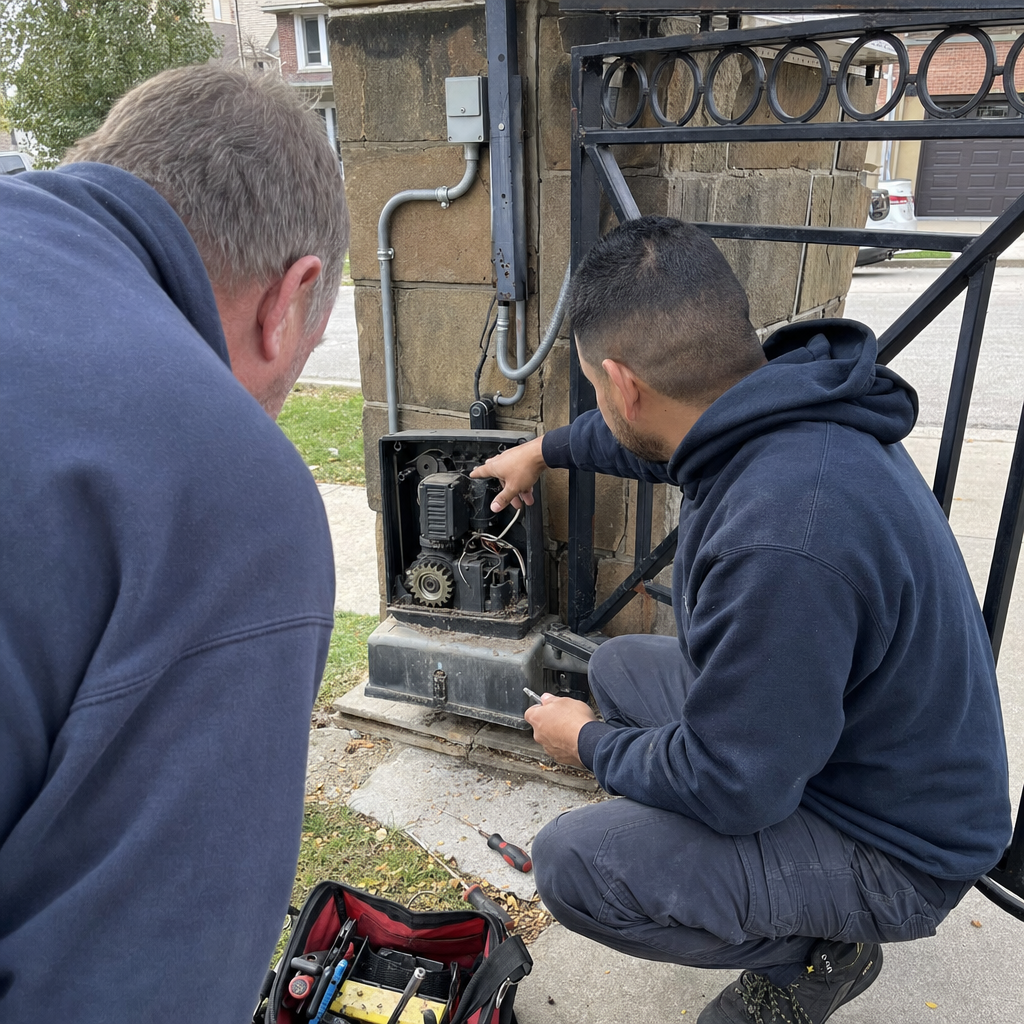
Why Is My Gate Motor Not Working in Chicago? Most “Motor Failures” Are Actually Load Problems
Your gate motor has probably stopped working because the gate itself is binding, dragging, or out of alignment — forcing the motor to draw excess current until its thermal protection trips or a component burns out. In Chicago’s alley-gate environment, where decades of frost-heaved posts and corroded iron frames create mechanical resistance, the motor is usually the victim of a structural problem, not the root cause. If you’re seeing intermittent stops, complete non-response, or a motor that hums without moving, the fix often costs far less than replacing the operator — but only if someone diagnoses the actual failure mode correctly. Call Fortress Gate Repair Greater Chicago at (866) 406-5812 for a same-day assessment.
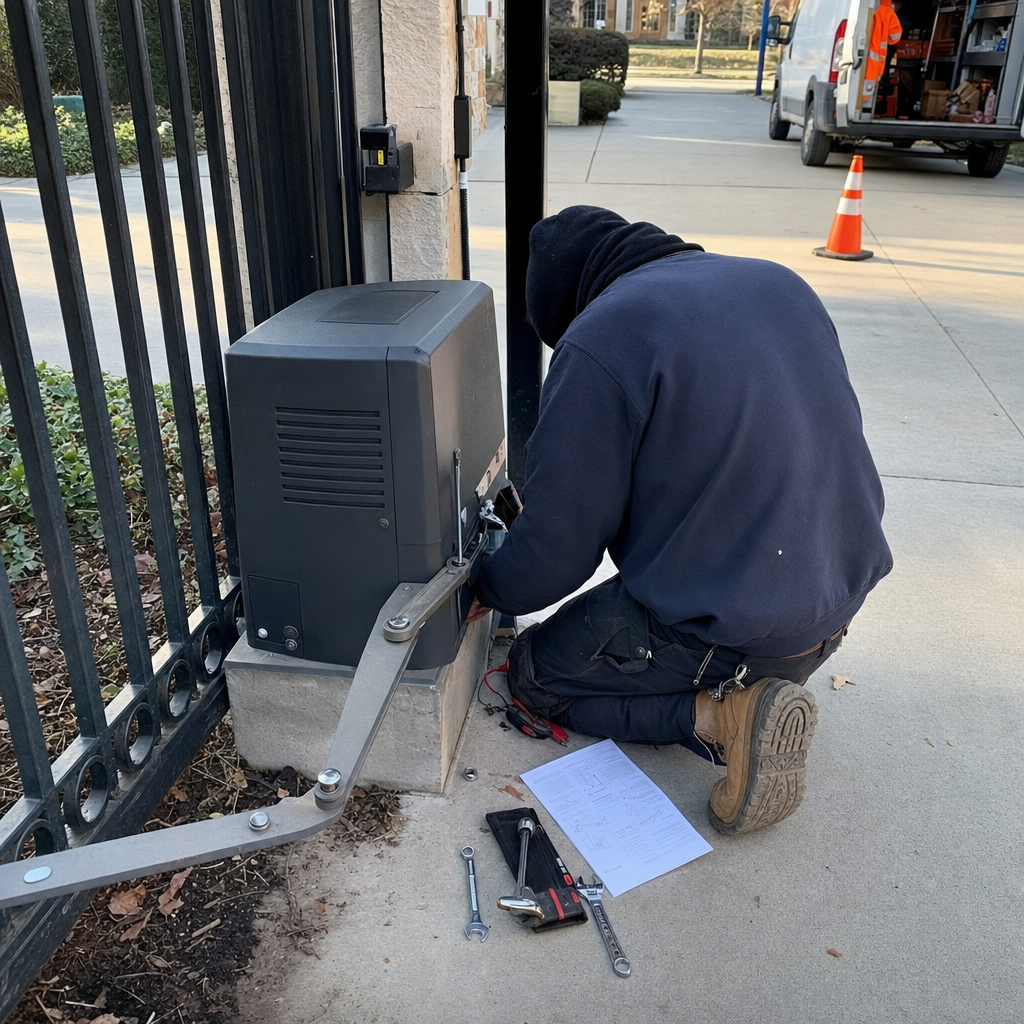
Jason’s Rule: Age of Failure Tells You What to Look For
After 14 years of working on gate systems across Chicago, Jason Reed — our Owner and Lead Technician — uses a simple diagnostic shortcut that rarely steers him wrong. If a gate motor fails before it’s seven years old, he assumes the gate is binding or out of alignment and the motor burned out under abnormal load. If it fails after twelve years, he assumes normal wear finally caught up. These two scenarios cost very different amounts to fix correctly, and confusing them is how homeowners end up paying for a new LiftMaster or FAAC operator when a $180 hinge adjustment would have solved it.
This distinction matters enormously in Chicago, where the city’s roughly 1,900 miles of paved alleys create a gate-repair context unlike anywhere else in the country. Nearly every residential lot backs up to an alley, meaning the dominant gate type we service is a rear alley-access gate serving a detached garage — not a front driveway statement piece. These gates take decades of abuse from salt spray, freeze-thaw heaving, and casual impacts from garbage trucks and snowplows. The motor was never designed to overcome that accumulated mechanical resistance.
“Tell me what it’s doing — or not doing — and I can usually tell you what’s wrong before I pull into your driveway,” Jason says. That confidence comes from knowing that in neighborhoods like Portage Park, Archer Heights, and Brighton Park, alley gate posts were almost universally set in shallow piers that don’t reach Chicago’s 42-inch frost line. After sixty to eighty winters of heaving, a leaning or non-latching gate isn’t an exception — it’s the default condition. The motor burns out trying to pull a twisted frame through its travel.
How Chicago’s Climate Destroys Gate Motors From the Outside In
Chicago’s heavy clay soils amplify freeze-thaw heaving dramatically. Gate posts not anchored below that 42-inch frost line shift out of plumb every winter, progressively destroying hinges, latches, and frames. By spring, the gate that swung freely in October now drags against the jamb or grinds along the pavement. The motor doesn’t sense this gradually — it just works harder, draws more amperage, and eventually fails.
Meanwhile, road and sidewalk salt spray combined with Lake Michigan humidity accelerates rust on iron gates faster than in inland cities at the same latitude. We’ve opened control boxes on alley gates in Bridgeport — Jason’s old neighborhood, a few blocks from what was still Comiskey when he was growing up — and found terminal blocks green with corrosion, limit switches frozen by salt aerosol, and circuit boards with traces eaten through. The motor itself was fine. The motor couldn’t get fine power, or couldn’t tell where the gate was in its travel.
Here’s what we check first on every “dead motor” call in Chicago:
- Post plumb and pier depth: Is the gate frame square, or is frost heave twisting it against the motor’s rated pull force?
- Hinge and pintle condition: On Chicago’s original wrought-iron alley gates, worn or broken pintles create binding that feels like motor failure.
- Limit switch contacts: Salt-corroded contacts on Mighty Mule and Elite systems especially cause intermittent non-starts that seem like random motor failure.
- Thermal cutout history: Has the motor stopped on hot days, then worked again after cooling? That’s excess load, not electronics failure.
- Control board LED status: FAAC, BFT, and Viking units display brand-specific fault codes that pinpoint the subsystem — if you know how to read them.
The Thermal Cutout: Chicago’s Most Misdiagnosed “Motor Failure”
On hot summer days, we get calls from Chicago homeowners whose gate worked at 8 AM but stopped by 2 PM. By 7 PM, it might work again. This pattern confuses people because it feels like an electronics problem — heat sensitivity, maybe a failing capacitor. Usually it’s simpler: the motor’s thermal protection circuit tripped from excess current draw, and reset when the motor cooled.
Here’s what’s happening. Every gate motor — whether it’s a LiftMaster slide operator in Lincoln Park or a FAAC articulated arm in Oak Park — is rated for a specific gate weight and duty cycle. When post heave or frame binding puts the gate out of true travel, the motor pulls 30–50% more current to complete its stroke. On a cool morning, the motor sheds that heat fast enough. By afternoon, with ambient temperatures in the 80s or 90s and the motor housing baking in direct sun, the thermal cutout trips. The motor isn’t broken. It’s protecting itself from a mechanical problem someone hasn’t fixed.
We’ve had customers in Portage Park tell us their Viking operator “died” three summers in a row, and each time a different company sold them a new motor. The fourth call came to us. Jason found the gate post had heaved two inches, the frame was binding against the catch post, and the original motor was still within spec — it was just doing a job three times harder than designed. We reset the post, realigned the frame, and reinstalled the same motor. That was four years ago. It’s still running.
Motor Hums But Won’t Move vs. Dead Silent: Two Completely Different Diagnoses
This distinction separates actual gate specialists from general contractors who “do gates too.” When you press your remote and the motor hums but the gate doesn’t move, the motor is receiving power. The problem is mechanical — a seized bearing, a binding track, a frozen hinge, or an obstruction in the travel path. The motor is trying. It can’t.
When you press the remote and hear nothing at all — no hum, no click, no LED flash — the control board isn’t sending signal to the motor. This could be a failed transformer, a blown fuse, a corroded terminal block, a fried relay, or a logic board damaged by voltage spike or moisture intrusion. These two conditions are diagnosed with different tools, repaired with different parts, and priced on completely different scales.
On BFT and FAAC systems, the control board’s diagnostic LEDs will tell a certified technician exactly which subsystem has faulted. On a recent call in Brighton Park, a customer’s FAAC 746 operator showed a steady red LED on the board — not a motor code, but a “obstacle detected” fault that kept the system in safety lockout. A generalist had quoted $1,400 for a new motor. Jason cleared a pebble wedged in the rack, reset the limit switches, and cleared the fault in twenty minutes. The motor was never the problem.
Safety note: Gate motors operate on 110V or 220V power and can develop lethal stored charges in capacitors even when unplugged. If your motor hums but won’t move, do not attempt to force the gate manually or disassemble the operator housing. The mechanical resistance could release suddenly, and internal electrical components pose shock hazard. A trained technician has the lockout tools and discharge procedures to work safely.
Salt, Corrosion, and the $50 Fix That Looks Like a $900 Problem
Chicago’s winter road salt creates a specific failure mode we see weekly on alley gate motors. Salt spray aerosol — kicked up by traffic, spread by plows, suspended in Lake Michigan humidity — settles on exposed electrical contacts. On limit switches especially, this creates a resistive film that interrupts the low-current signal telling the control board “the gate is fully closed” or “the gate is fully open.”
The board interprets missing or erratic limit signals as a fault. It may refuse to start. It may stop mid-travel. It may run the motor continuously trying to reach a limit it can’t confirm. To a homeowner, this looks like catastrophic motor failure. To us, it’s often a $12 limit switch or thirty minutes with contact cleaner and a brass brush.
We’ve replaced more limit switches on Elite and Mighty Mule operators in Chicago than we have motors — not because those brands are poorly made, but because their limit switch designs expose the contact points to alley environments in ways that FAAC’s enclosed rotary encoders, for instance, avoid. Knowing these brand-specific vulnerabilities is part of why Jason’s nine-brand fluency matters. We work on LiftMaster systems every week — we know them cold. Same for Viking, DoorKing, Ghost Controls, Linear, and the rest.
What Gate Motor Repair Actually Costs in Chicago
Because “motor not working” covers multiple failure modes, Automatic Gate Opener Installation Cost in Chicago, IL ranges widely. Here’s what we typically see for Chicago alley-gate systems, based on 14 years of field data:
| Problem Type | Typical Range | What’s Included |
|---|---|---|
| Limit switch or contact cleaning/replacement | $85 – $175 | Diagnosis, parts, adjustment |
| Control board repair or replacement | $220 – $480 | Board, programming, testing |
| Capacitor or internal motor component | $180 – $340 | Component replacement, recalibration |
| Post reset and gate realignment (solves “motor failure”) | $350 – $650 | Excavation, concrete, alignment |
| Full motor/opener replacement | $1,100 – $2,400 | Unit, mounting, programming, testing |
The critical point: replacing a motor without fixing the underlying load cause means you’ll be replacing it again. We’ve been called to properties in Archer Heights where three motors had failed in eight years. The post was still heaved. The frame was still twisted. Each previous company sold the symptom, not the cure.
From a broken hinge weld to a full access-control install — one call covers it. Our Gate Motor & Opener in Chicago service includes complete diagnostic, repair, and replacement for all nine brands we support.
When to Call a Professional vs. What You Can Check Safely
There are two things any homeowner can check without risk: whether the gate moves freely by hand (disconnected from the motor, if your operator type allows manual release), and whether the circuit breaker feeding the operator has tripped. Beyond that, the electrical and mechanical hazards escalate quickly.
What you should not do: open the motor housing, attempt capacitor testing, force a stuck gate with the motor engaged, or bypass safety devices to “test” the system. Gate motors develop significant stored energy, and a suddenly released bind can cause uncontrolled gate movement capable of serious injury.
What we do on every Gate Motor & Opener services diagnostic call: measure actual current draw against manufacturer spec, check limit switch continuity with a multimeter, inspect the full mechanical travel path for binding, read control board fault codes on brands that provide them, and test post plumb with a laser level. This takes 20–40 minutes and tells us whether you’re looking at a $140 contact cleaning or need to discuss replacement options.
FAQs
Your motor’s thermal protection is tripping from excess current draw, then resetting when it cools overnight. In Chicago’s summer heat, a motor already struggling against a binding gate or heaved post will hit its thermal limit by midday and shut down for safety. The motor isn’t failing — it’s protecting itself from a mechanical problem that needs fixing first. Call (866) 406-5812 for a free estimate; we’ll measure the actual load and tell you whether it’s an alignment issue or something internal.
Repair is usually cheaper if the motor is under seven years old and the failure is electrical — limit switches, capacitors, or control boards typically run $85–$480 to fix. Replacement becomes the better value when the motor is over twelve years old, has suffered multiple thermal events, or when the repair cost approaches 60% of a new unit. The expensive mistake is replacing a motor without fixing the binding or alignment that killed the first one. We quote both paths honestly; call (866) 406-5812 for exact numbers on your system.
Most gate motor repairs in Chicago fall between $85 and $480, depending on whether it’s a contact cleaning, component replacement, or control board issue. Full motor replacement runs $1,100–$2,400 installed. The wild card is post-heave realignment, which can add $350–$650 but prevents repeat failures. We don’t charge for the diagnostic if you proceed with our repair. Call (866) 406-5812 for a free on-site assessment with exact pricing.
Yes — for most brands we carry common failure parts in our service vehicle, and Jason Reed works your job directly as Lead Technician, so there’s no delay coordinating subcontractors. Same-day completion depends on whether the issue is component-level (usually yes) or requires concrete work for post reset (typically next visit). For urgent security concerns, we prioritize Emergency Gate Motor & Opener in Chicago, IL calls where a gate is stuck open. Call (866) 406-5812 and we’ll give you a realistic timeline based on your symptoms.
Get a Straight Diagnosis on Your Gate Motor
If your gate motor isn’t working, the worst move is guessing — and the second-worst is hiring someone who’ll guess with your money. Fortress Gate Repair Greater Chicago offers a no-pressure assessment: Jason Reed shows up, diagnoses the actual failure mode with meters and brand-specific knowledge, and quotes the fix that solves the root cause. We’ve earned 639 customer reviews at a 4.7-star average by being the Best Gate Motor & Opener in Chicago, IL company that fixes it once. Call (866) 406-5812 for a free estimate in Chicago.
Written by Jason Reed, Owner & Lead Technician at Fortress Gate Repair Greater Chicago, serving Chicago, IL.