
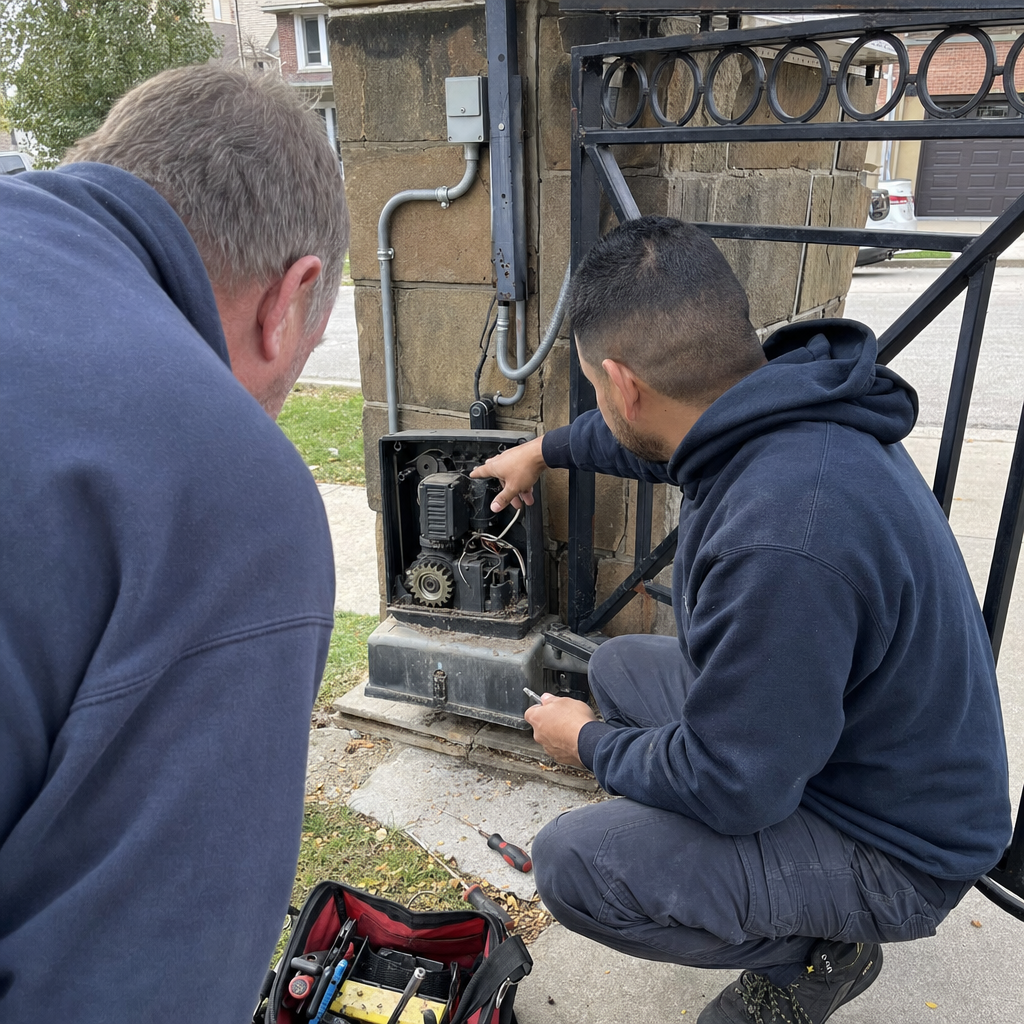
How an Automatic Gate Opener Works in Chicago’s Alleys and Yards
An automatic gate opener converts electrical energy into mechanical force to move a gate leaf along a defined path, using a motor, control board, and position-sensing system that stops precisely at open and closed limits. In Chicago, that same system must also compensate for gate frames that shift every winter due to frost heave in our heavy clay soils, making the structural mounting — not the motor — the most failure-prone part of the whole setup. If your opener starts reversing for no apparent reason every spring, that’s usually not a motor problem — it’s the gate telling the opener it’s somewhere it isn’t, which is why we often point customers to our guide on Why Is my Gate Motor Not Working? (Chicago, IL) before scheduling a visit. Call Fortress Gate Repair Greater Chicago at (866) 406-5812 — we’ll diagnose it over the phone and confirm on-site.
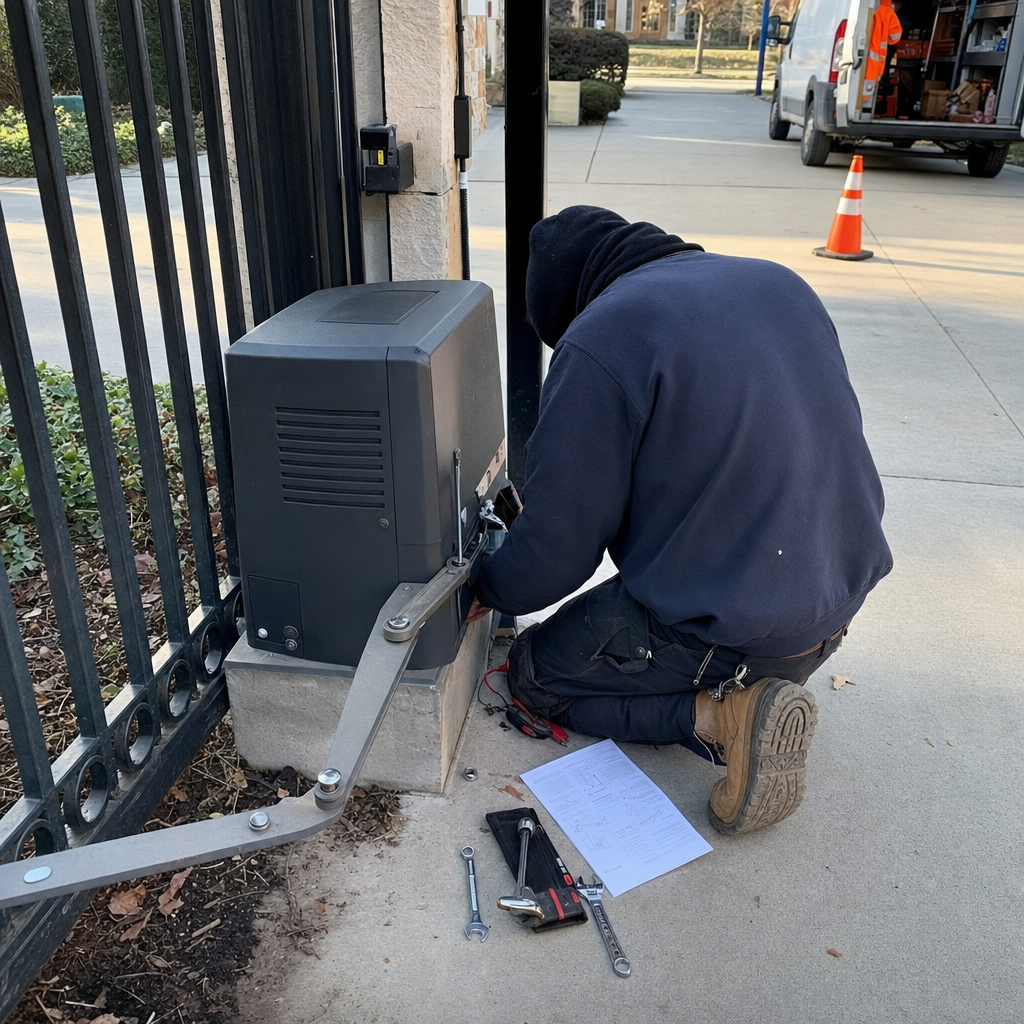
We’ve spent 14 years working on gate openers in Chicago’s alley-gate economy, where nearly every residential lot backs up to one of the city’s roughly 1,900 miles of paved alleys. That context changes everything about how these systems fail and how we fix them. The ornamental wrought iron and steel alley gates on bungalows, two-flats, and greystones — most of them 60 to 100 years old — weren’t built with automation in mind. We retrofit openers onto heritage metalwork that flexes, rusts, and leans, then we calibrate those openers to keep working as the ground beneath them moves.
The Four Systems Inside Every Gate Opener — and Why Chicago Tests the Fourth Hardest
Most online explainers break a gate opener into three parts: motor, controls, and safety sensors. We look at it as four systems because the mounting and gate structure determines whether the first three can function at all.
- Actuator / Motor: The power unit that generates torque. On swing gates, this is typically a linear or articulated arm (LiftMaster LA500, Elite CSW200) or an underground hydraulic operator (FAAC 770, BFT SUB). Slide gates use a chain-driven or rack-and-pinion motor (DoorKing 9100 series, Viking G-5) that pulls the gate along a track. The motor doesn’t “know” where the gate is — it only knows to run forward or reverse at a set speed and force.
- Control Board: The brain that processes commands from remotes, keypads, loop detectors, or intercoms. It manages start/stop timing, obstacle detection sensitivity, and accessory integration. Boards from Elite and DoorKing are particularly modular, which matters when a Chicago customer wants to add a telephone entry system to an existing opener without replacing everything.
- Travel Sensing: Limit switches or magnetic encoders tell the control board where the gate is in its arc. Mechanical limit switches (common on Mighty Mule and older LiftMaster units) are physical contacts that click at endpoints. Magnetic encoders (standard on FAAC, BFT, and newer Viking systems) read position continuously. This is where frost heave causes chaos — more on that below.
- Structural Mounting: The posts, hinges, and frame that hold the gate and anchor the opener. In Phoenix, this is a set-and-forget component. In Chicago, it’s a seasonal maintenance item.
Jason Reed — Owner and Lead Technician at Fortress Gate Repair Greater Chicago — grew up in Bridgeport and learned motors and controls through the HVAC and Industrial Maintenance program at Triton College in River Grove before spending two years in general fence work and then narrowing to gates exclusively. “Tell me what it’s doing — or not doing — and I can usually tell you what’s wrong before I pull into your driveway,” he’ll say on a service call. That diagnostic speed comes from understanding how these four systems interact, especially when Chicago’s climate starts pulling them out of alignment.
How Limit Switches and Encoders Create “Phantom Obstructions” After Winter
Here’s the Chicago-specific failure pattern that generic explainers never cover.
When a swing gate opens, it travels through a fixed arc — say, 90 degrees from closed to fully open. The opener’s control board expects that arc to take a consistent amount of time and motor current. Limit switches or encoders mark the endpoints so the motor knows when to stop.
Now consider a gate post in Portage Park, Archer Heights, or Brighton Park — neighborhoods where alley gate posts were almost universally set in shallow piers that don’t reach Chicago’s 42-inch frost line. Every winter, freeze-thaw cycles in our heavy clay soils heave that post half an inch, maybe an inch. The gate frame shifts. The hinge geometry changes. The arc the gate actually travels is now slightly different from the arc the opener was calibrated for.
The opener doesn’t understand soil mechanics. It only knows that the motor is drawing more current than expected, or that the encoder reading doesn’t match the programmed limit, or that the gate hasn’t reached the limit switch in the expected time. Its programmed response: “Something’s blocking the gate. Reverse for safety.”
So the gate starts, moves a few inches, and immediately reverses. Or it reaches what it thinks is the end of travel and stops short, leaving a gap. We get these calls every March and April, and the solution is almost never a new motor. It’s re-plumbing the post, re-hanging the gate, and recalibrating the limit switches or encoder positions — a structural fix followed by a control adjustment.
This is why we work on Gate Motor & Opener systems as an integrated discipline, not as isolated component swaps. A technician who only knows openers will replace your control board twice before checking whether the gate frame is square.
Access Control: How Keypads, Loops, and Remotes Talk to the Opener
The control board’s accessory inputs determine what can trigger the gate. Here’s how the common interfaces work:
Remote receivers listen for radio frequency signals — typically 310, 315, or 390 MHz on residential systems, with commercial DoorKing and Elite systems sometimes using 433 MHz or proprietary rolling-code encryption. The receiver passes a dry contact closure to the control board’s “open” input. We see plenty of Chicago jobs where the receiver works fine but the antenna coax has corroded where Lake Michigan humidity gets into the enclosure.
Keypads and intercoms wire directly to the control board or communicate through a dedicated slave board. DoorKing’s 1830 series and Elite’s E-SWIM systems use two-wire communication that carries both data and low-voltage power, which simplifies retrofitting on older gates where pulling new conduit through a hundred-year-old alley wall isn’t practical. Our certification on both brands means we can add or upgrade access control without replacing a functioning opener — something general contractors often won’t attempt because they don’t know the protocol compatibility.
Loop detectors sense vehicles through an inductive wire buried under the driveway or alley approach. The loop’s magnetic field changes when metal passes over it, signaling the control board to open (entry loop) or hold the gate open until the vehicle clears (exit loop or safety loop). In Chicago, loop wire must be rated for direct burial and temperature cycling — we’ve replaced loops that failed because standard wire couldn’t handle our freeze-thaw.
Photoelectric safety beams mount across the gate opening and send an infrared beam between transmitter and receiver. Break the beam, and the control board stops or reverses the gate. These are required by UL 325 safety standards and are non-negotiable on any automated system we install or service.
Real Chicago Scenario: Ghost Controls TU2 on a Bridgeport Two-Flat
We installed what we’d rank among the Best Gate Motor & Opener in Chicago, IL — a Ghost Controls TU2 dual swing — last summer on a two-flat near 33rd and Halsted, classic Bridgeport brick with an ornamental steel alley gate that had been hand-operated since the 1950s. The owner wanted automation but had no power at the alley post, which is common on detached garage setups.
The TU2 runs on 12V DC with a battery backup system, and we paired it with Ghost’s 10-watt solar panel kit mounted on the gate frame itself. The panel keeps the battery trickle-charged; the battery runs the opener. In full sun, the system is self-sustaining. In Chicago’s shorter winter days, the battery still carries several weeks of normal cycles with minimal solar contribution.
The critical detail: every spring, we return to recalibrate the travel force adjustment. The TU2 uses current-sensing obstacle detection — it measures how hard the motor is working and reverses if resistance spikes. After winter heave, the gate hinges bind slightly differently. Without recalibration, the opener either becomes too sensitive (reversing on every cycle) or too aggressive (straining the motor and hinges). We schedule this as a 30-minute seasonal service, and it prevents the emergency calls that come from ignored drift.
This is the maintenance calendar we recommend for any automated gate in Chicago, tied to the opener’s mechanics and our climate:
| Season | Service Focus | Why It Matters in Chicago |
|---|---|---|
| Spring (April–May) | Post plumb check, hinge inspection, limit switch / encoder recalibration | Frost heave peaks during thaw; gate frame is at maximum misalignment |
| Summer (June–July) | Battery backup load test, solar panel cleaning if equipped, safety beam alignment | Storm season demands reliable backup power; peak sun hours for solar verification |
| Fall (October–November) | Limit switch calibration, corrosion inspection on control enclosures, drain check | Pre-freeze baseline before heave begins; salt spray season starts |
| Winter (January–February) | Emergency-only; monitor for reversal patterns indicating heave progression | Cold-weather grease stiffens; major adjustments deferred to spring thaw |
Generic annual maintenance doesn’t work here. The opener’s mechanical systems interact with soil movement on a seasonal rhythm, and the service schedule should match.
What to Check Before Calling — and When to Call
If your gate opener isn’t behaving, there are a few safe observations that help us diagnose over the phone:
- Does the motor make any sound when triggered, or is it completely silent? Silent usually means power or control board; humming or clicking suggests motor trying against resistance.
- Does the gate move freely by hand with the opener disengaged? If not, the problem is mechanical — hinges, post, or frame — not the opener.
- Does the issue follow a pattern — only in morning cold, only after rain, only since March? Seasonal patterns point to environmental causes.
- Are safety beams aligned and unobstructed? Even a spiderweb across the receiver can cause refusal to close.
We do not recommend DIY adjustment of travel force settings, limit switch positions, or any component under spring or hydraulic tension. These settings determine crushing force and entrapment risk. A misadjusted opener can close on a vehicle or person with lethal consequences. If you’re not trained on the specific brand’s calibration procedure, call us.
Fortress Gate Repair Greater Chicago services nine major brands — home to our full service overview — and we carry parts and programming tools for LiftMaster, FAAC, BFT, Linear, Viking, Ghost Controls, DoorKing, Elite, and Mighty Mule. We work on DoorKing and Elite systems every week — we know them cold. From a broken hinge weld to a full access-control install — one call covers it.
FAQs
Frost heave has shifted your gate frame out of alignment, so the opener’s limit switches or encoders detect unexpected resistance or position mismatch and trigger safety reversal. In Chicago’s clay soils, this is predictable — we recalibrate limit positions every spring for dozens of properties. Call (866) 406-5812 for a same-week appointment; estimates are free.
Usually yes, if the control board has accessory inputs and the brand is one we support — DoorKing and Elite systems are particularly modular for this. We evaluate the existing board’s input capacity and communication protocol, then recommend compatible keypads or telephone entry systems. A full replacement is only necessary if the board is obsolete or physically damaged. Call (866) 406-5812 to discuss your current setup.
Most service calls for opener issues in Chicago run $180–$340 for diagnosis and adjustment, including limit switch recalibration, safety beam realignment, or control board programming — see our full breakdown of Automatic Gate Opener Installation Cost in Chicago, IL for project-level pricing. Parts replacement — control boards, motors, receivers — typically adds $150–$600 depending on brand and model. Structural repairs like post re-plumbing or hinge welding are priced separately based on materials and access. We provide upfront pricing before any work begins. Call (866) 406-5812 for an exact quote — estimates are free.
Yes, with proper battery sizing and realistic expectations. Systems like the Ghost Controls TU2 with 10W solar panel and dual 12V battery configuration handle typical residential cycle counts through Chicago winter, though heavy snow cover on the panel may require occasional clearing. The battery, not the panel, carries the load during short-day months. We size battery capacity for 2–3 weeks of zero solar input and verify performance during our summer installation. Every spring recalibration visit includes battery load testing. Call (866) 406-5812 to assess solar feasibility for your specific gate and sun exposure.
Key Takeaways
- An automatic gate opener is four systems — motor, control board, travel sensing, and structural mounting — not three.
- In Chicago, frost heave in heavy clay soils makes structural mounting the highest-maintenance component, causing “phantom obstruction” behavior that mimics motor failure.
- Limit switches and encoders must be recalibrated seasonally, not annually, to match our freeze-thaw cycle.
- Access control additions are often possible on existing openers when the technician knows brand-specific protocol compatibility.
- Solar-powered openers work in Chicago with proper battery backup and seasonal maintenance verification.
If your gate opener is reversing unexpectedly, stopping short, or not responding to remotes, we’d rather diagnose it correctly than sell you parts you don’t need. Fortress Gate Repair Greater Chicago offers no-pressure assessments throughout Chicago — from Bridgeport to Portage Park, from Brighton Park to the near-north greystones. Call (866) 406-5812 for a free estimate, or describe the symptoms and we’ll tell you what we’re likely looking at before we arrive.
Written by Jason Reed, Owner & Lead Technician at Fortress Gate Repair Greater Chicago, serving Chicago, IL.