Gate Welding Repair in Chicago: On-Site Fabrication for Wrought Iron & Steel Alley Gates That Parts Catalogs Can’t Fix
Gate welding repair in Chicago typically costs $150–$350 per weld zone for picket, hinge, or frame repairs, with most jobs completed same-day on-site. For gates with frame distortion or multiple failed joints, section replacement runs $400–$800. Call (866) 406-5812 for a free estimate — Jason Reed, Owner & Lead Technician at Fortress Gate Repair Greater Chicago, brings the welding equipment to your alley, not the other way around.
Last October we got a call from a landlord in Portage Park. His tenant had backed into a 1940s wrought iron alley gate — snapped the bottom hinge weld clean off, and the frame had twisted enough that the latch wouldn’t catch. A fence company had already been out, looked at the pintle hardware, and told him nothing in their supplier catalog matched the profile. They suggested replacing the whole gate. What they didn’t tell him: the picket spacing, the 1¼-inch square stock dimensions, and the hand-forged strap hinge configuration were all fabricated in-place seven decades ago. No catalog carries that. We brought a Miller multiprocess welder to the alley, cut out the cracked heat-affected zone, fitted a new pintle boss to the original dimensions, and welded it solid. Two hours. Gate swung true. That’s not a handyman job, and it’s not a fence-company job — it’s a fabrication job.
Why Chicago’s Old Iron Gates Fail at the Weld First
We’ve spent 14 years in Chicago’s alleyways, and we’ve developed a pretty good sense of what kills these gates. It’s rarely the motor — even on automated systems — and it’s rarely the pickets themselves. The failure point is almost always the weld joint, and there are three reasons that keep us busy from Bridgeport to Brighton Park.
Freeze-thaw cycling cracks old welds at the heat-affected zone. Chicago’s frost line sits around 42 inches deep, and the heavy clay soils in this region amplify heaving dramatically. When a gate post shifts even half an inch out of plumb over winter, every swing puts torque on the hinge welds. After 60–80 winters, that repeated stress concentrates at the heat-affected zone — the brittle area immediately adjacent to where the original weld was laid down. We’ve opened up hinge welds on greystone gates in Pilsen that looked intact from the outside but were cracked 80% through the throat.
Lake Michigan humidity rusts from the inside out. The humidity coming off the lake, combined with road salt spray that gets into every alley in Chicago, creates a corrosion environment that’s harsher on iron than inland cities at this latitude. We’ve cut into frame tubes that looked solid from the exterior and found the interior wall reduced to scale. That rust undermines weld integrity before you ever see a problem — by the time the gate sags or the latch quits catching, the weld is already compromised.
Shallow post piers guarantee progressive frame distortion. On the northwest and southwest bungalow belts — Portage Park, Archer Heights, Brighton Park — alley gate posts were almost universally set in shallow concrete piers that don’t reach the frost line. After decades of heaving, a leaning or non-latching gate isn’t an exception; it’s the default condition. That post movement stresses every joint in the frame, and the welds take the load first.
Here’s what we check on every welding repair call:
- Heat-affected zone condition around existing welds — surface cracks often indicate deeper failure
- Post plumb and pier depth — welding a hinge to a post that’s still moving is a waste of your money
- Frame square and diagonals — a racked frame will destroy new welds the same way it destroyed the old ones
- Interior wall thickness on tubular stock — we use a borescope where access allows, or cut a test window if we suspect internal corrosion
- Hardware mating surfaces — pintles, strap hinges, and drop rods on Chicago’s old iron often need custom fabrication to match original dimensions
Weld Repair vs. Replacement: When to Fix and When to Rebuild
This is where a gate-only specialist earns the call. We’ve seen general contractors and fence companies default to replacement because they can’t assess weld viability accurately — or because they don’t have welding capability in-house and it’s easier to sell a new gate. Here’s how we actually make the decision.
| Condition | Repair Range | Typical Approach |
|---|---|---|
| Single broken picket weld, sound frame | $150–$250 | On-site MIG weld to original profile, cold-galvanize and touch-match finish |
| Hinge weld failure, plumb post, sound frame | $200–$350 | Cut out heat-affected zone, fit new boss or pintle, weld and dress |
| Multiple weld failures, minor frame racking (under 1 inch) | $350–$550 | Frame pull and square, then weld repair at all failure points |
| Frame distortion over 1 inch, or internal corrosion | $400–$800 | Section replacement with custom-fabricated matching stock |
| Full gate replacement with custom fabrication | $1,200–$2,800 | In-house design to match original picket spacing and iron profile |
The threshold question is always: can we restore structural integrity without creating new failure points? A frame that’s racked more than an inch will stress fresh welds asymmetrically — we’ll pull you back from the edge and show you why. We’ve walked property managers through this on Archer Heights two-flats where the impulse is to “just weld it” but the math doesn’t work. When section replacement makes more sense, we fabricate in matching stock — 1¼-inch square, ½-inch picket, whatever the original spec was — so the repair doesn’t read as a patch job.
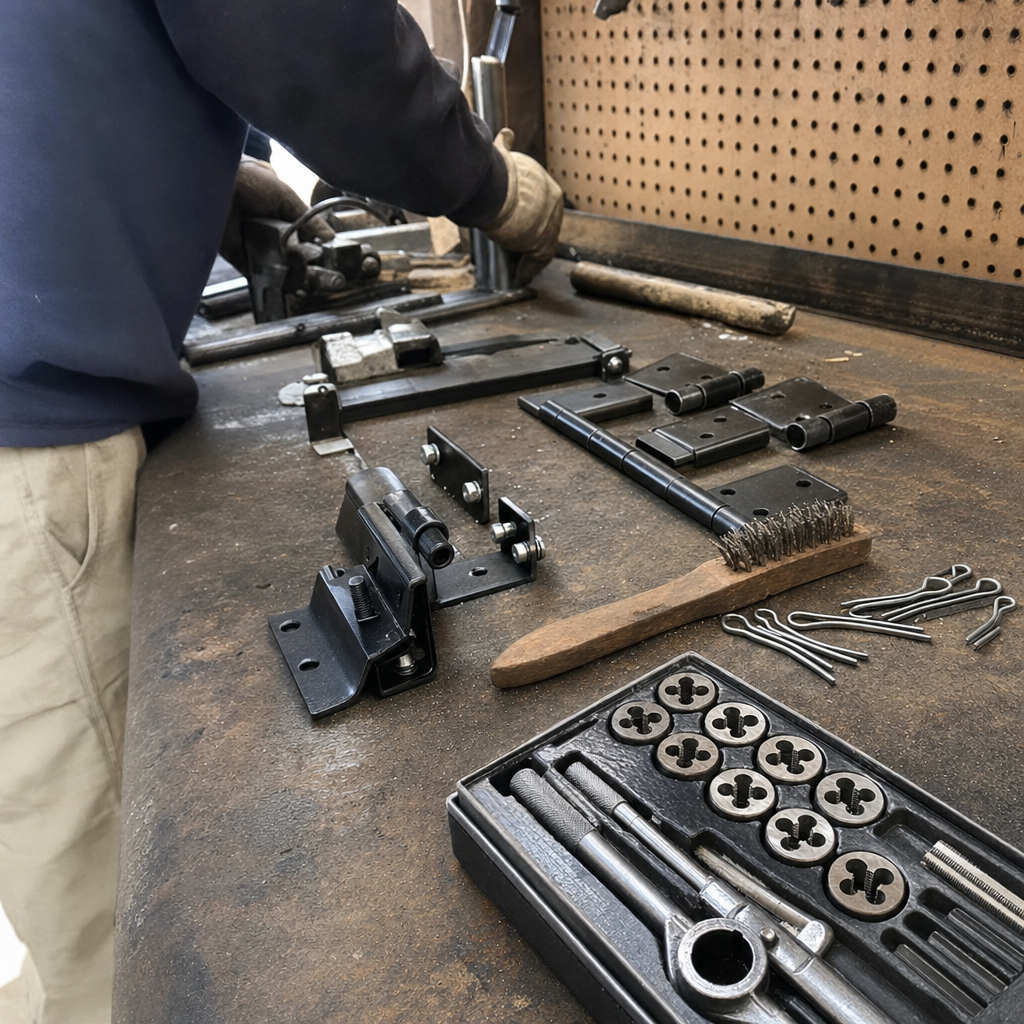
Our Gate Parts & Welding service covers the full fabrication capability: custom pintles, strap hinges, drop rods, and latch hardware that hasn’t been manufactured commercially for decades. We don’t source this from a catalog. We build it.
Field Welding: Why We Bring the Shop to Your Chicago Alley
Chicago’s approximately 1,900 miles of paved alleys — more than any other American city — mean nearly every residential lot backs up to one. The dominant gate repair context here is rear alley-access gates serving detached garages, not front driveway gates. This shapes everything about how we work.
You can’t trailer a 12-foot iron gate out of a Chicago alley for shop repair. The access is too tight, the gate is often integrated with masonry piers, and the post connections are buried. So we don’t. Jason Reed — Owner and Lead Technician — loads a Miller multiprocess welder, oxygen-acetylene cutting rig, and portable fabrication table into the service truck. We weld in the alley, in the conditions the gate actually lives in.
That field capability matters for reasons beyond convenience. When we’re welding a hinge repair on a gate that’s been racked by post heave, we can check our work against the actual operating conditions — gate open, gate closed, latch engagement — in real time. A shop weld that’s perfectly square on a bench can bind when it’s hung on a post that’s shifted 3 degrees out of plumb. We adjust for that on-site.
We’ve worked on BFT slide gate operators in Bridgeport where the gate frame itself had cracked at a weld, and the motor was throwing fault codes that another technician had diagnosed as a control board failure. It wasn’t. The frame flex was binding the rack, overloading the operator. We welded the frame, realigned the rack, and the BFT ran clean. That’s the kind of misdiagnosis that happens when gate work is treated as secondary — when the tech knows motors but doesn’t read the mechanical system.
Same story with a Linear swing operator in Brighton Park last spring. Customer had been told the actuator was shot. Jason found a cracked top hinge weld that let the gate drop ¾ inch — the actuator was hitting its mechanical limit early because the gate geometry had changed. Weld repair, hinge adjustment, operator recalibrated. Saved the customer a $600 actuator they didn’t need.
We work on Linear and BFT systems every week — we know them cold. Same for Viking, Ghost Controls, and the other five brands we cover. But the motor knowledge only matters when it’s paired with mechanical diagnostics. That’s what 14 years of gate-only focus gets you.
Custom Fabrication for Hardware That Doesn’t Exist Anymore
The ornamental iron on Chicago’s bungalow-belt gates — the scrollwork, the spear points, the graduated picket patterns — was largely produced by small foundries and fabrication shops that closed decades ago. When a strap hinge cracks or a pintle boss shears off, you can’t call a supplier. We’ve had property managers in Pilsen show us hardware they’ve been chasing for months.
We don’t chase. We build.
Jason’s background is worth mentioning here — he came up through the HVAC and Industrial Maintenance program at Triton College in River Grove, which gave him a solid foundation in motors, controls, and metal systems before he ever touched a gate operator. That training shows in the fabrication work: proper joint prep, correct amperage for the material thickness, controlled heat input so we don’t create new brittle zones adjacent to the repair. We’ve seen “welded” gates in Chicago that were clearly done with a 110-volt flux-core machine from a hardware store — cold, porous, guaranteed to crack next winter. That’s not what we do.
Our typical custom fabrication calls in Chicago include:
- Pintle bosses and straps matched to original 1940s–1960s iron profiles
- Drop rods and cane bolts for double-leaf alley gates with non-standard spacing
- Latch hardware with extended throws for gates that have settled out of alignment
- Frame repair sections in matching square or rectangular stock
- Automation mounting plates for retrofits on gates that were never designed for operators
We also handle Viking and Ghost Controls retrofits on old iron that was never meant to be automated — fabricating custom mounting brackets, reinforcing hinge points for the added torque, and programming limit switches to account for gates that don’t quite hit the same stop point every cycle. The automation brands are our daily vocabulary, but the ironwork is what makes the automation possible.
Where We Do This Work: Chicago’s Bungalow and Two-Flat Belts
The highest concentration of gate welding repair demand we see follows the housing stock. Portage Park, Archer Heights, Brighton Park, Bridgeport, Pilsen — these are the neighborhoods where original ironwork is still in place, where the alleys are narrow and the gates are old, and where the freeze-thaw cycle has had 60–80 years to work on every weld joint.
We’re not inventing neighborhood names for SEO. We’re telling you where our truck is every week, where we’ve developed a sense of the typical pier depths, the common iron profiles, the recurring failure patterns. A gate in Portage Park is likely to have the same shallow pier and 1¼-inch square frame as a gate in Archer Heights because they were built from the same stock in the same era. That pattern recognition speeds our diagnostics and keeps your cost down.
We’ve also done significant welding repair work in Lincoln Square, North Center, and Logan Square as those neighborhoods’ vintage housing stock ages into the same repair cycle. The greystone alleys behind the main streets — the service entrances that don’t show on the postcard — that’s where the iron is, and that’s where we work.
What to Expect on a Gate Welding Repair Call
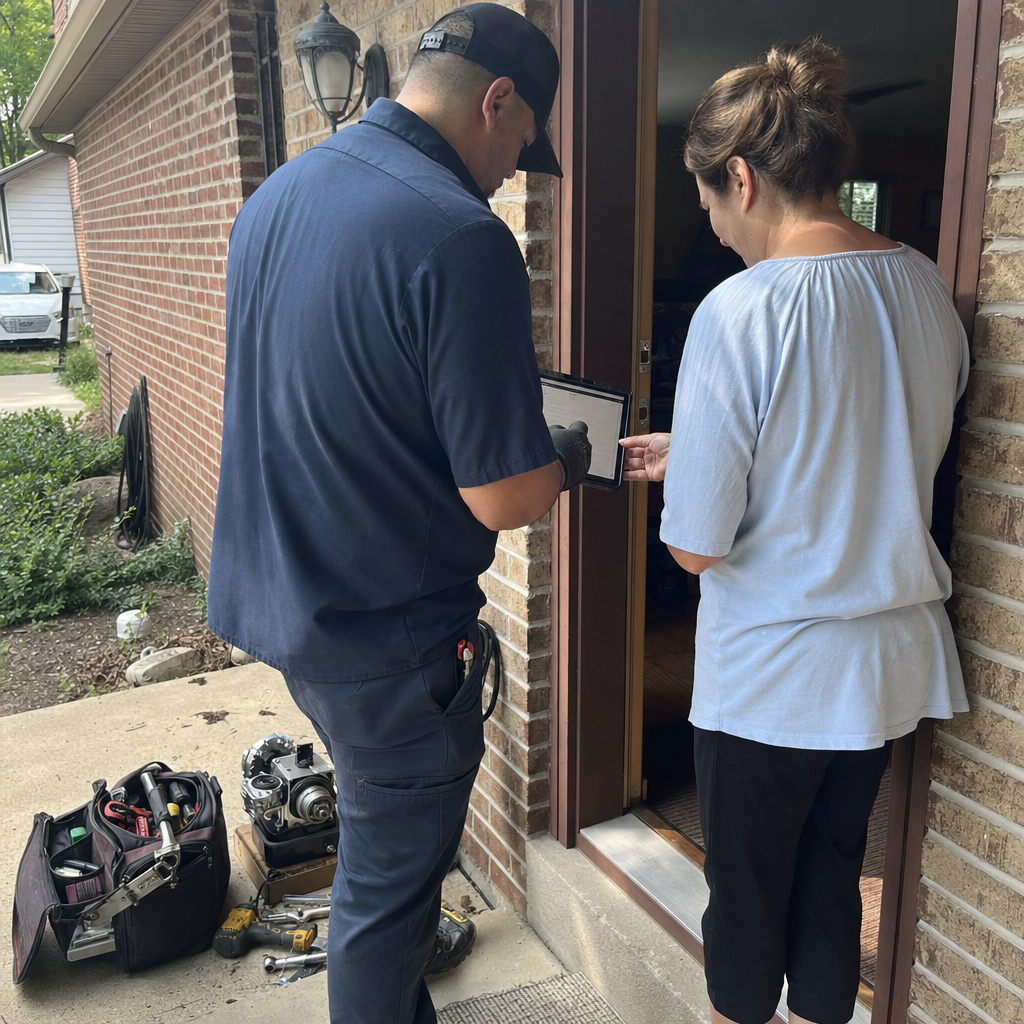
When you call (866) 406-5812, Jason Reed picks up or calls back fast — usually within the hour during business hours. We’ll ask what the gate is doing, or not doing, and we can usually tell you what’s wrong before we pull into your driveway. That’s not a parlor trick; it’s pattern recognition from 14 years and 639 customer reviews worth of gate problems.
On arrival, we assess the mechanical system first — frame, hinges, posts, welds — then the operator if there is one. We give you a verbal range before we start work, and a written invoice after. No hidden charges, no upsell to replacement unless the math genuinely supports it.
Most single-weld repairs in Chicago take 1–2 hours on-site. Multiple failures or section replacement might run half a day. We carry common steel stock, but for unusual profiles we may need a day to source matching material — we’ll tell you upfront if that’s the case.
Our 639 verified reviews at a 4.7-star average reflect this approach: direct assessment, honest options, clean execution. From a broken hinge weld to a full access-control install — one call covers it.
FAQs
Single weld zone repairs typically run $150–$350, while section replacement for distorted frames ranges $400–$800. Full custom fabrication with replacement gates starts around $1,200. Call (866) 406-5812 for an exact quote — estimates are free.
We weld on-site in your Chicago alley — no removal needed. Our truck carries a Miller multiprocess welder, cutting rig, and portable fabrication equipment. Trailering a gate out is rarely practical with masonry pier connections and tight alley access.
Weld repair is more economical when the frame is fundamentally sound and distortion is under 1 inch. Once frame racking exceeds that threshold, or internal corrosion is significant, section replacement or full fabrication becomes the better long-term value — we’ll show you both options and explain why. Call (866) 406-5812 and we’ll assess it honestly.
Most welding repair calls are scheduled within 24–48 hours, and same-day service is often available for security-critical situations. We serve the full Chicago metro from our base operation. Call (866) 406-5812 — we’ll get you on the calendar.
Call Fortress Gate Repair Greater Chicago for On-Site Gate Welding
A broken weld on vintage Chicago iron isn’t a problem you solve with a catalog part or a general contractor’s referral list — it’s why property managers search for best gate parts & welding in Chicago, IL when standard fixes fail. It’s a fabrication problem, and it needs a gate specialist with welding capability who works in Chicago alleys every day. Jason Reed — Owner and Lead Technician — brings 14 years of focused gate expertise and in-house welding equipment to your property. Call (866) 406-5812 now for a free estimate. We’ll look at your gate, tell you straight whether welding makes sense, and get it swinging true again.
Written by Jason Reed, Owner & Lead Technician at Fortress Gate Repair Greater Chicago, serving Chicago, IL.